

Teanna is writing a novel narrated by an egotistical 11 year-old who speaks in medieval cadence. Jesse is writing a comedy about four queer Black friends in their late twenties. Marlo is on year six of a serialized drama he has been editing, in part, with his therapist. All three of them claim to be introverts. All three of them are correct. None of them came to MSLCE to learn how to write.
Another thing these MSLCE students have in common is, all three have talked about work that sat unfinished or a confidence that wavered. What MSLCE has given them, in different ways and by different routes, is permission. Permission to finish. Permission to call themselves what they already are. Permission to stop asking.
Jesse: The Showrunner in Training
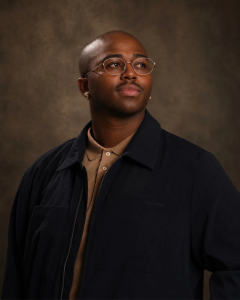 Jesse Lane introduces himself as a writer and editor, with a specific long game ambition: he wants to be a showrunner. “The way it’s always been taught to me is that showrunners are the medium between the business side and the creative side,” he says. “I feel like I have a good grasp on the creative side. That has always come naturally to me. It’s the business that has not come as easily.” The MSLCE program is where he’s learning the second half of that job: leadership, budgeting, and speaking the language of the stakeholders.
The shift in his thinking since he started has less to do with craft than with authorization. “The way I thought about my work, honestly, came with a lot of uncertainty. Not being sure in myself or sure in what I was writing or putting out. Being in the MSLCE program, and being surrounded by so many confident and smart people, has honestly encouraged me to put out the best work I can.” He can name, without flinching, the failure mode the program broke: “Some projects in the past were not that great. But some were good, and I just let it sit there. I did not do anything with it.” The fix is simple and hard. “If you want it, do it. You’ll find a way to do it. I don’t need permission from someone else to do it.”
The moment he keeps returning to is his professional development class taught by Mandi Glowen and the accountability groups inside it. “We would just talk about what our goals were. That was so refreshing just being able to talk openly and honestly. Mandi told us: be honest with your group. Make sure you are holding each other accountable.” Tangible outcomes followed. His classmate, the other Jessie in the cohort, helped him land an editing gig. He and Zach went to a community theatre show together. People offered to help on each other’s projects. “I’m going to hold on to that memory.”
His current script, Full Circle, follows four queer Black friends navigating their mid-to-late 20s. “A la Noah’s Arc, Sex and the City, Queer as Folk, but I feel like this generation doesn’t really have anything like that.” He wants the show to live in a register the genre rarely gives Black queer characters: “Relatable, but not necessarily based in tragedy. A lot of the media I see that centers Black queer stories is sad, and it is tragic. This is more of a dramedy. It’s going to be light, and you’re going to laugh.”
The longer play is geographic. “I really want to be a part of the group of people who make the Chicago film scene great, and bring specifically writing jobs here. I don’t believe writing jobs should be centralized only in LA.” He points to Tyler Perry’s studio in Atlanta as a model. His closing advice to himself, and to anyone else: “Just go out and do. Just do art.”
Teanna: The Poet Writing Her First Novel
 Teanna White began writing in sixth grade. A weird fiction story in a notebook, “random and had a lot of different elements in it”, passed around her classroom, and her classmates started fighting over who got to read what she was working on next. “I decided at that moment that I wanted to really be an author.” By the end of middle school, poetry had become her primary medium, and it has stayed that way ever since.
What’s changed since she arrived at MSLCE is less what she writes than how she gets herself to the page. “I wasn’t a super procrastinator, but navigating my own work, it felt like I was having a hard time getting out of my way and just doing the work and getting things done. This program really pushed me to complete, to start and finish.” She credits two classes specifically, Strategic Storytelling, which sharpened her ability to make a story feel both real and compelling, and Influencers IRL: Decision-Making + Strategy in Creative Context, which reframed storytelling as persuasion.
The shift was underwritten by a single moment in her Professional Development accountability group — the same class that reshaped Jesse. Teanna was describing how badly she wanted her book to matter, to mean something to her community. Jesse’s response was almost offhand. “He was like, well, regardless of anything, you’ll still be an author and that counts for something.” She replays the lesson like a verdict she’s still absorbing: “I just need to do the work, and if the work is good, it will go far.”
Her first fiction novel is underway. The protagonist is an 11 year-old girl “who’s big and egotistical and talks in this medieval-like tone in her writing. I’m just having fun exploring her.” The hardest part isn’t the character; it’s the world around her. “World building, making sure things are consistent, making sure the characters make sense. One of the most important parts of writing, especially when you’re creating a story, is not only making it real but making it compelling.”
The moment she’ll carry from the year is sensory and small. In Influencers in Real Life, the class played a game where everyone stood and tried to convince each other they were telling the truth. “I just remember being there and everybody in the class interacting. I felt really safe.” Her takeaway from MSLCE, delivered in her own cadence: “Be open and be kind to each other and be generous, with yourself, with your ideas, with your concepts. Because you never know where it can take you.”
Marlo: The TV Writer Who Came Back to Love It
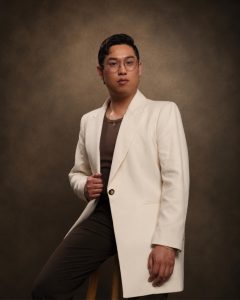 Marlo Abril-Viriña came to MSLCE burnt out. He had worked his way from production assistant into writing, then into production coordinating and assistant directing. “After all that, to be honest, I was a little burnt out. I came to MSLCE to figure out either how to get out of that, or to find new passion within creativity.”
What he brought with him was Manic Man, a serialized drama, half live-action and half animation, that he has been developing for six years. The show follows Malcolm, a young man moving through trauma, depression, grief, and addiction. “Similar to my own story, he finds out how to process all of that messy stuff of the real world through art, through writing this comic book, Manic Man.” Writing it has been, in his own description, an act of therapy as much as craft. “As I’ve revised it over these six years, I’ve really had to sit with myself a lot and question why I’m doing this, why I’m writing this, and what I really want to say.” Somewhere in that process, something else shifted. “It changed how I did therapy. I started giving my therapist homework. I started to send her pieces of my writing to talk to her and unpack all of those feelings. That’s how I channel all of my emotions. So why not work with my therapist and incorporate that into my writing process?”
MSLCE has done two things for Marlo at once. The first is a craft sized surprise. Exposure to the program’s theatre artists rekindled a love he’d lost touch with in undergrad. “Theatre has this feeling of being such a playground, a sandbox. It made me want to capture that again in my own television writing.” The second is a reframe of himself. ” [The Power of] Pitching and Persuasion helped me understand that there is power in being an introvert. It changed how I looked at myself in the mirror. It changed how I carried myself through the world. It gave me a really great sense of confidence I don’t think I would have gotten otherwise.”
The surprise of the program has been Nonprofit Arts Development, not a path he walked in considering, and now the one he’s most pulled toward. Guest speakers in his Cultural Nonprofit Organizations class sparked what he calls “honestly an obsession with wanting to help artists get connected with the resources and the funds that are needed to make their projects. As an artist, I understand that is often the first and biggest battle you have to work through.”
What’s next is both expansion and return. He wants to keep building the world of Manic Man, and to collaborate with Chicago’s Filipino theatre troupe CIRCA Pintig, specifically with artistic director RJ, on a staged reading as a first step toward fundraising. He also wants to come back to writing not as a professional obligation but “…as this thing I love.”
The Permission Slip
What Jesse, Teanna, and Marlo have in common is not a genre, a medium, or a career plan. It is the particular condition of being a writer who already writes, and who still needed something the quiet work of writing alone couldn’t give them. Jesse needed classmates who would hold him accountable. Teanna needed a sentence from Jesse, delivered in the same accountability group that reshaped him, that she keeps repeating to herself. Marlo needed a class to tell him that his introversion was not a deficit.
The permission didn’t come from the faculty, or at least not only from them. It came from each other. Three quiet writers, in a program full of louder ones, writing each other’s permission slips in real time.
Jesse closes his own interview with an instruction: Just go out and do. Just do art. By the sound of it, all three of them have.
Written by Jessie B. Evans MSLCE ‘26
Credits
Executive Producer/Creative Director: Jessie B. Evans
Photographer: Dmytro Cherkaskyi
Senior Producer: Sophia Agusta
BTS: Zach Kanner, Xuanyi Zhao