 Questions about the future of work are everywhere. But the answers many leaders are looking for don’t appear as they look toward what’s next. Sometimes, they’re hiding in the details of what already happened.
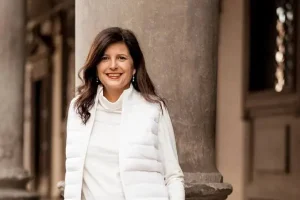
That’s why Professor Leslie DeChurch’s research moves between the two—future and past—and examines how they inform one another.
To do this, her work centers on three areas:
- Identifying best practices to help teams thrive in space as they solve problems and sustain teamwork despite physical confinement, social isolation, and communication delays.
- Investigating the impact of AI on collaboration in the workplace. “AIs work with other AIs, and people work with AIs,” DeChurch explains. “We’re looking at how the social dynamics of teams change when AI enters the picture.”
- Using management history to stress-test modern leadership ideas against real people and decisions from the Renaissance. By coding letters, records, and other artifacts from Renaissance leaders, she surfaces patterns that can be turned into lessons for today’s decision-makers on moving creative work forward.
Everything she studies comes down to this: cultivating a better understanding of how people collaborate under extreme uncertainty and constraint, and how they come together to unlock collective potential.
DeChurch brings these concepts together in a practical way for students as she weaves her research into two MS in Leadership for Creative Enterprises (MSLCE) courses.
Learning to Lead Teams with AI in the Mix
In Managing AI in Creative Industries, DeChurch works alongside two other faculty members (Professors Ignacio Fernandez and Duri Long) to give students a multi-layered view of what it means to lead with AI. They each focus on a different part of how AI changes leadership. Together, they help students see its impact on individuals, teams, and organizations.
For example, one course module centers on AI literacy and design, while another looks at how organizations make decisions about jobs, policies, and practices as AI tools become more embedded in everyday work. DeChurch’s section of the course zeroes in on team dynamics: what it means to lead people who work with, alongside, and through AI tools.
“I take my knowledge of teamwork in the human-AI world and translate it so MSLCE students can think about how they collaborate in smart ways with AI,” she describes. “It’s about augmenting capabilities and not degrading the things they’re truly good at and passionate about. I teach them how to strategically position AI as they develop others so it doesn’t replace people, create conflict, or duplicate effort.”
Because the course is designed to be flexible, faculty can quickly and effectively align the AI-relevant leadership skills covered in class with what’s happening in the real world. As a result, every year, the course changes—from the tools and case studies it highlights to the AI-relevant challenges and opportunities that are discussed.
Studying Modern Leadership Through the Renaissance
That same set of questions about teams and leadership also drives DeChurch’s other MSLCE course … but in a very different setting.
The Global Leadership: Lessons from the Renaissance course was born after a stretch of years shaped by the pandemic. DeChurch was ready for students to experience “the opposite of decontextualized Zoom,” as she explains it. “I wanted a completely contextualized class taking place where the leadership we’re studying actually unfolded.” The setting: Florence, Italy, a city that’s been the epicenter of creativity through different periods of history. It serves as a backdrop to explore what leadership looked like during the Renaissance, and why it still matters to creative work today.
Last year (2025) was the first year for the course. It was held over spring break and open to alumni of the MS in Communication program in conjunction with its 40th anniversary. This year (2026), MSLCE students are invited to join as well; the course will take place during winter quarter. In addition to enrolling in Global Leadership: Lessons from the Renaissance as an MSC or MSLCE course, students can also complete it to receive an Executive Education Certificate in Leadership.
To prepare, some work is done asynchronously, including a few Zoom sessions and discussions. These early conversations focus on leadership strengths, effective team-building, and the patterns that can limit mid-careers leaders if they aren’t addressed.
DeChurch describes the experience as a place-based academic executive education program where the case studies essentially come to life as students walk through the spaces where those stories took shape alongside art and the Renaissance. In one week, students move through 600 years of creative, cultural, and leadership history, from late medieval art into early Renaissance work to modern luxury fashion like Ferragamo, Gucci, and Prada.
Over the week, students visit sites like Medici palaces, museums, churches, and contemporary businesses, and hear from local experts on topics like female leaders of the Renaissance, patronage, and modern brand storytelling. And they’re constantly finding ways to connect what they’re seeing and learning back to their own careers: ways to build trust, share power, scale and sustain high-impact teams amid rapid change, and adapt creative enterprises and personal leadership styles to new conditions.
“We’re tracing the leadership of visionary strategists. It’s almost like Disney World for MSLCE: You can see this leadership case, and this leadership case, all within a few steps. There’s a variety and breadth of creative organizations here that are built on a shared DNA of creativity and human potential. I think of it as a global leadership incubator. We’re constantly asking: ‘How do you apply this to your life and job right now?’ ”
The course has also become a powerful way to network, bringing current students and alumni together, as well as students from the two School of Communication programs. Together, they practice how to lead real people through real uncertainty, and then take those lessons back into the creative industries they’ll help shape next.
Read more on our blog and follow Northwestern’s MS in Leadership for Creative Enterprises program on Instagram, Facebook, and LinkedIn.